Ok. You have got this far. You have decided on filming with children as part of your video. Some might call you brave, while others may recall the old WC Fields adage of ‘Don't work with children or animals’.
These skeptics may have a point, likely based on past experiences with both.
So, take a moment to consider whether you truly want or need children in your video. Filming with children involves a complex process and stringent practices, presenting numerous challenges to overcome.
This Broadley Studio Guide offers valuable insights into the necessary steps when filming with children, whether in a studio or on location.
What's your motivation for including children in your production? There could be numerous reasons. Their innocent faces, brimming with curiosity and awe, serve as powerful natural marketing tools in the business world.

Children often feature in kids TV shows, advertisements, and corporate videos to imbue products with a unique charm.
Buyers place trust in the innocence of children, as they can lend a friendly and approachable feel to the product or message.
However, shoots involving kids often come with unexpected surprises, given their unpredictable nature. While these surprises can enhance your piece, they also have the potential to disrupt the entire production. Hence, it's crucial to handle such situations with care.
You have to imagine yourself when you were young or perhaps what your own children are like now!
Children are often restless, disliking routines and struggling to maintain focus. Moreover, they may not readily comply with instructions, especially in demanding environments. The repetitive nature of filming, with its repeated words and actions, can feel foreign to them.
Additionally, children must navigate listening to adults, which any parent knows is no easy feat. Your best bet is to find the right child for the job. Avoid selecting based solely on appearance, as the child may lack experience. Instead, enlist the help of a reputable agent who can guide you through the casting process, rehearsal techniques, and obtaining necessary licenses.
Be aware that they will be mostly looking to squeeze the maximum amount of hours out of you, and your preparation time for their 10% commission so be careful to choose representatives wisely. Or, if you choose a fresh-faced unknown they will not have representation so you may have to approach the school or guardian and tell them you want to make their child a star (for a day at least anyway!).
Read the information below which will offer guidance on how to go about filming with children.
The skill is to provide a relaxed but focussed environment. You will most certainly have a limited schedule so make sure that you block out the day and actions before the shoot.
Maybe during this process you can shoot a rough video shot list that can be shown to the child as an example of what they need to do. (kids are like sponges so don’t swear at any point during the shoot or they’ll be repeating everything you don’t want and little of what you do want them to say!).
This video could also be a useful tool for preparing for your licence application. It will show the type of work the child will be asked to do and it will give the application board an insight as to the type of production company that you are.
Be firm but gentle, if you are the director or floor manager or whoever will be giving the child the most directions and information, It is best to find some time to speak to the child personally with their guardian present.
Explain the actions and what is to be expected of the child actor. This will give the guardian some peace of mind for the rest of the shoot too!
Talk clearly and directly to the child. Explain the safety rules and how the day will go. Describe the sequence of events leading up to a take so they are aware of the voices they will be hearing. Make it fun. Get involved. Act out the scene or action briefly for the child so he is prepared mentally for the next take.
Any child you wish to use for any studio production must be licensed. So speak to their Local Education Authority.
Casting can be done through the child’s agent who will have more information about their next steps. Obtaining a licence is an absolute must and any child working without a licence can be removed from the studio and any future productions involving children may have their licence application turned down.
One of the conditions is that you must allow an inspector, who may even turn up randomly, to check your licence and premises and they will be thorough with their investigation into the environment and the safe working practices of the production.
After you have contacted the child’s LEA and gone through their procedures on filming with children to apply for a licence, you will have to wait for around 10 days for the licence to be approved. There are some cases where it may take less time or more time - but allow for these 10 days to be sure and if you are unsuccessful in your application you maybe able to consider legal action with the local Magistrates Court.
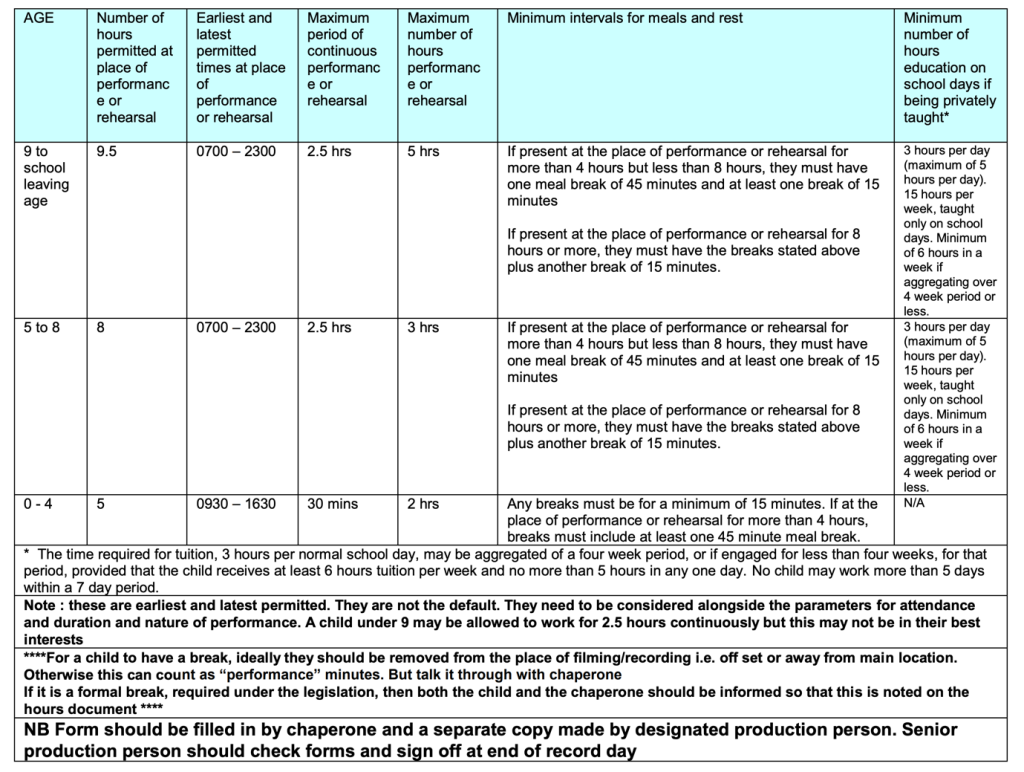
The amount the child can work is dependent on the LEA. There are some instances where the child must have at least 2 weeks break during a longer feature film or series productions so be careful to factor these elements in.
To make your life easier it is simpler to rehearse and block out the shoots with an adult stand-in so that when the child is ready the pre-lighting and stage directions are also ready. Just think if your key scene falls on the child’s legal break periods (these include the agreed 2 week break period or school hours) then shoots can be held up for weeks costing time and money.
Rehearsals do not require a licence but the rules surrounding working hours are still the same, the rehearsals must be declared on the licence application and permission from their legal guardian must of course be obtained. A child will not be allowed to shoot or rehearse for more than 5 days a week.
The following is a chart with the latest information on hours for children of different ages:
The number one priority when filming with children is the safety and welfare of the child. The licensing authority must be satisfied that:
• The location has stringent safety procedures.A guardian must be present for the child. They also have strict categories:
• The licence holder is responsible for ensuring that the child is supervised at all times. This applies to the guardian of the child too. They are often referred to as Matrons and a licence holding matron can be in charge of up to 12 children.When filming with children, the journey of casting, managing, and shooting your child star may be lengthy and complex, but it holds great potential for enhancing your product or service. You can't predict the adorable, unfiltered joy that children bring to a project or scene.
By following our tips and ensuring a safe, meticulously planned, and well-managed production, your child star will bring an extra layer of dynamism and quality that no adult actor could replicate.
Filming with children can be a logistical nightmare, but it doesn't have to be. Make sure you follow our tips and your shoot should run smoothly.
Remember, when filming with children, the key elements are:
1. Decide why you need to include children in your productionFinally, prepare a list of eveything you will need to have in place before you start production.
Broadley are here to make sure your filming days go off without a hitch.
For over 20 years, we've been helping countless productions to be the best they can possibly be. With our wealth of experience, we know the ins and outs of production challenges, including filming with children, and how to smooth them over for you.
To get a flavour of what we can do for you, check out our latest showcase and studio specs. Or take a virtual tour of our studios.
To find out more about our studios and production services and how we can help you and your shoot, please call us on +442077255858 or email us at [email protected].